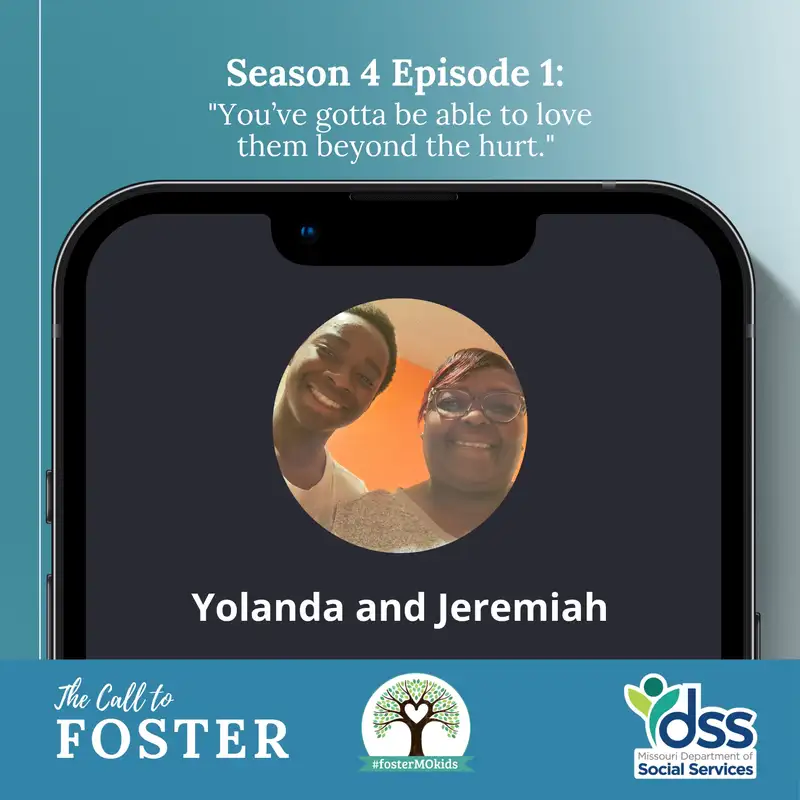
"You've gotta be able to love them beyond the hurt."
Welcome back. This is the Call to Foster podcast. My name is Shasta Miller, and I'm a regional director with the Southeast Missouri Children's Division. I am with my lovely two co hosts, and they are
Speaker 2:Jessica Hugstep, supervisor over the Southeast Region Resource Unit,
Speaker 3:And I'm Ashton Keber. I am the communications specialist for Children's Division.
Speaker 1:So listeners out there, I'm so glad you're with us today. We have a very special guest. She is a foster parent and her name is Yolanda. Yolanda, do you want to introduce yourself and just tell us, maybe start off by telling us how long you've been fostering and what brought you to make that decision to decide to foster?
Speaker 4:I've been fostering now fourteen months, and Jeremiah is my family, and I've been in the foster system the previous, and I just did not want my family in the system. And so that made me choose to support him and to make sure he's still with family.
Speaker 1:Oh, Yolanda. So I think what I heard you say is your foster care journey started before you were fostering. Right? And you were That is correct. Yeah.
Speaker 1:You were in the system and and it it kinda was a natural progression, right, when Jeremiah happened to be in this situation. You're like, nope, he's he's coming to my house. Right?
Speaker 4:Yes. That is correct.
Speaker 1:What so has Jeremiah been placed with you for the last fourteen months?
Speaker 4:He has.
Speaker 1:Okay. And is this and you said he is family?
Speaker 4:Yes.
Speaker 2:That's
Speaker 4:a Oh, it's a kinship.
Speaker 1:Kinship. Okay. Yes. Okay.
Speaker 2:I was wondering, Yolanda, so you said you were in the system as well. How has that impacted you in being a foster parent? Like, what did you learn from that or what mistakes were made when you're in care that has helped you become a better foster parent?
Speaker 4:Just knowing that somebody is there that cares. I've always been a caretaker provider, for my family. And so it was just natural that if he didn't have anywhere else to go, that he would come with me. That's just natural. My grandmother have always raised us because she came and got me out of the foster care system.
Speaker 4:I was five. Oh. No. I was four going on five years old, my sister and I.
Speaker 1:Okay.
Speaker 4:And she came and got us and raised us basically till we were grown. And just being in the foster care system away from my mom, I know how lonely and scared I felt at that young of a age
Speaker 1:Yeah.
Speaker 4:Not knowing what to expect. You know? Didn't know the people. And just the fear that was inside me during that whole time. I'm with strange people.
Speaker 4:It was hard for me to really connect because they wasn't family.
Speaker 1:Right.
Speaker 4:They were not people I were familiar with.
Speaker 3:Yeah. They didn't know who you were, where you came from, like, there's something really special about family bonds, you know, you like in my family, we've got traditions, we've got like little inside jokes, we've got things that even my aunts and uncles understand that maybe another person wouldn't, you know?
Speaker 4:Correct. And that's just, I mean, we my grandmother raised us that family was the most important thing. And if you can be there to provide and support and assist, then do that. But only do it within your well-being of yourself. Don't overdo it.
Speaker 4:Do it within your means of being able to provide for others.
Speaker 1:Yeah. I think that is I think that's great advice because you've got to be the only way you can be the best you, right, is if you're taking care of yourself and you kind of know your limits and your boundaries. Yolanda, I think part of your passion in Jeremiah being with you is you learned when you were a child, it's really scary to go to a stranger's home and you already had that connection with Jeremiah and you were like, don't want him to experience that again. Am I am I kind of on the right track?
Speaker 4:You are on the right track.
Speaker 3:Okay, so Jeremiah, would you just share your story with us? You can start wherever you like, but basically how did you get from your home, your biological with your biological parents to where you are now?
Speaker 5:Yeah. So Me and my mom didn't really have a house for a while, and we were usually staying with get there. Well, for a while, we stayed with her girlfriends, and then then her girlfriend got into an argument. So she wasn't, she was running to the store. I forgot.
Speaker 5:She was somewhere. She was going somewhere. I will be right back, but she had dropped me off at her ex girlfriend's house. And so she she, where's her mom? I said, she said she's coming up somewhere and coming right back.
Speaker 5:And so she called 71, I think I do. And they
Speaker 4:came and scooped
Speaker 5:me up and brought pesticides foster care. I left there for the night then woke up. They brought me all the way to the village of Binge, and I waited there until miss Renee got where she brought me to my auntie Nikki's house. And, yeah, that's how I yeah. Yeah.
Speaker 5:Was out of town.
Speaker 1:Okay. So I think I love how you said that Children's Division came and scooped you up, I'm sure it felt like we were scooping you up, right? Maybe talk about Jeremiah, like, how it felt in that moment. Did you understand what was going on?
Speaker 5:Whenever Johnson's Vincent came and scooped me up, I saw my mom walking back.
Speaker 4:Mhmm.
Speaker 5:I guess I was she didn't know it would be up in that car, so I still try and stop her and everything. But I saw her walking, and then whenever whenever I got there I mean, I was just I've been on the phone with, my grandma the whole time. So
Speaker 1:Okay. It
Speaker 2:sounds like you're pretty resilient.
Speaker 5:Yeah. I wasn't really well, I was worried about my mom, but I was just worried about where I was going. But the place I was was that it was really fun. There was a couple of younger kids there. They were really playful.
Speaker 5:Had me tired out. And the plate was really big. Oh, was it? I
Speaker 3:can't imagine how busy they must have been to tire out a 12 year old.
Speaker 2:Yeah. Like I can't.
Speaker 1:A trackster at that.
Speaker 3:For real. So
Speaker 2:so since Jeremiah was placed fourteen months ago, how has that journey been? Was it rough in the beginning, or was it
Speaker 3:a piece of cake? I
Speaker 4:have to laugh because I'm like, we're still even though we're the king, it's still like because my baby is 32 years old.
Speaker 5:Wow. So This is I
Speaker 4:had Jamal, he was 12, and now he's a 13 year old teenage boy. And it's like, I forgot about them days.
Speaker 1:Yolanda, I I actually have a 13 year old myself and there's something about this age for all 13 year olds.
Speaker 2:I agree.
Speaker 1:Not just ones in the system or outside of the system, but that age 13 is is unique and
Speaker 2:It's rough.
Speaker 1:It is rough, so bless your heart. Especially since your your baby is now a 32 year old adult. So, kudos to you. Thank you. What keeps you hanging on?
Speaker 1:What keeps you invested in Jeremiah's well-being?
Speaker 5:Love. Love.
Speaker 1:Love. Very very
Speaker 4:simple. It's it's just that simple. Anyone who is fostering must have a passion and a love for people because you're gonna be challenged with many things because you're you're gonna be dealing with their behaviors, their situation, their circumstance, but you gotta have some compassion and empathy because you don't know what they've been through. You don't know where they come from. And so you just gotta be able to love them beyond the hurt.
Speaker 1:Yep. I love that. That is great.
Speaker 4:Deep inside, they're hurting because they love their parents. They wanna be with their parent, and it's the most hurtful thing to see a child longing for their parent, but their parent is not capable of providing them what they need.
Speaker 2:Yep. Yep. So how have you, Yolanda? I don't know. I guess I should ask this first.
Speaker 2:Does Jeremiah have a good relationship or what does that look like with his biological parents?
Speaker 4:They have great relationships, but the relationships may not be the best because, like, the parent the mom, their relationship is more of he's more parenting her than she's parenting you.
Speaker 5:Mhmm. Yep.
Speaker 4:You know? And now I'm like, nephew, you don't have to parent me. Let me be the parent. You be the child. And so but this comes from what he's had to deal with all this time.
Speaker 2:Sure. And that's so true.
Speaker 4:But they have a good communication relationship. It's just she needs to be the parent parent
Speaker 1:Right.
Speaker 4:Right. And not his friend. You know? Like, he loves them. Him and his dad, they have a relationship.
Speaker 4:They I'm not saying it's it's strange. It's just that due to family dynamics of him and his mom, it it's kinda hard Mhmm. For them to really have a relationship.
Speaker 2:Yeah. I can't even imagine. Yeah.
Speaker 4:So I tried to be neutral, and, you know, it sometimes get hard because there is some kinda, you know, there was situations that have happened with me and the mother. And like I told her, all I've ever been was good to you, but I will still love you in spite of the things that has occurred to raise your child and be in place where you are not able to be Yeah. In spite of situation and circumstances that have happened.
Speaker 2:Yolanda, I just want to commend you for even being able to do that because people do struggle with that, right? To love them through it. Even though whatever you've done, you're not saying it's okay, but you're loving them anyways. Love them anyways. Right.
Speaker 1:Well, I think you have some really good advice for staying neutral, as you said, staying neutral, right? Because you have a job to do and that's to make sure Jeremiah is safe and make sure that he's taken care of and that you're loving him to the best of your ability and you also love his mom and can support her, maybe not her behavior, you recognize that there is a natural connection there and you just kind of have to stay in the middle sometimes and I think that's really good advice for listeners or especially new foster families that, and you're kind of new, right? You've only been doing this for fourteen months but you sound very wise. Yes. Correct.
Speaker 1:And that could and I think some of that and maybe I'm wrong here, but I think some of that is maybe you can take a lot from your own childhood and think through what you would want that foster parent to be like or maybe some things you experience that you are like, I don't want anyone to experience that and so I think and strengths too, right? I think maybe that's some of it is you had your own experiences in the system on the other side, you kind of know, you've kind of walked the same path as Jeremiah and maybe that's why it's a good fit for you. Right? Because and you get it.
Speaker 4:I get it. I I am a protector, and I I really had to learn that because it was, I I'm a just say it. I was in church, and there was a evangelist. And she just told me, and she spoke this to me, and she said, you are a spiritual leader, and you protect others because you always wanted to be protected when you wasn't. And that's what God has your passion of protecting others.
Speaker 4:You go above and beyond. And I and when she told me this, I just kinda looked at her because this lady did not know me. And I'm looking at her. All I could do was cry out because
Speaker 5:Oh my.
Speaker 4:It was a point in my life where I felt like, Lord, am I able to do this? Am I able to be there for Jeremiah? Yeah. Because I just felt like I could, and she spoke to me and she told me. Because I'm standing there, and I'm praying, and I'm saying, Lord, help me.
Speaker 4:Mhmm. Can I be there for him? Am I doing the right thing for him? And and, you know, because we you have to protect the child even when the child think. That's right.
Speaker 4:Really protected if they're like this That's right. Feel like you're all you all you hear is no. No. No. No.
Speaker 4:No. But it's for their protection.
Speaker 5:Yeah. Mhmm.
Speaker 4:Yeah. And you try to explain to them, but they just want what they want.
Speaker 5:Yep. And that that's
Speaker 4:been the challenges, and I would tell any foster parent, try to go to counseling. Try to go to family counseling.
Speaker 5:I think
Speaker 1:Try to
Speaker 4:get the families to do counseling because that's my next step is trying to get him and his mom to go to counseling together.
Speaker 2:That would be, yes.
Speaker 4:Because that would help a lot.
Speaker 1:That would. I think that's excellent, excellent advice and, you know, I think counseling also brings a different perspective to the table because when you're in it, when you're in a situation, your perspective is different, right, than if you're in a neutral setting like a counselor and can really see both sides of the situation or story or whatever the case may be. So really, really great advice.
Speaker 4:You
Speaker 1:also mentioned the lady at church, right? Yolanda, what would you say about how how important is it for foster parents, foster families to have that support? And that support may look different from foster family to foster family, but, what would you say in reference to supports that you need?
Speaker 4:I say that if you have a avenue to be able to go and get the pressures of fostering off, that is the best resource there could be. It don't necessarily have to be church. You can get in your room, turn on your music, whatever. But having that avenue or resource to be able to go to to get frustrations out, it helps. It helps me.
Speaker 4:I I don't believe with without spiritual guidance that I would be able to really maneuver this because I I cry out a lot. Mhmm. I would just be honest because it is hard. Yeah. And some days, I just I I'd be like, I wanna give up.
Speaker 5:Yep.
Speaker 4:I I wanna let go, but there's a fear in me if I let go, what will happen? Yep. And I don't want anything to happen on my watch that I was able to do, but because I was selfish and didn't wanna give back, something happened. You know what I'm saying?
Speaker 1:I know.
Speaker 4:So I tell any foster parent, if they're join the the the foster parent association, join the meetings. Even though I don't go to a mall that often, I have my church family
Speaker 1:Right.
Speaker 4:That I pray with, that pray over us, you know, that's my nucleus.
Speaker 1:I think you hit on something that's raw and I think very transparent, especially for the listeners to hear. I think it's a scary it's a scary thing, right, to be a foster parent and have that pressure of keeping kiddo a safe, a kiddo that's not of your blood or a kiddo that's not, you know, close to your family or yet close to your family. You really hit on, that's a true fear, scary thing and you gave some great advice as far as cry out, reach out to your support, get your frustrations out, join the Foster Association, get your network tech together because I think it it is hard and listeners out there, if if you're considering being a foster parent, know this, Yolanda is telling you, it's hard. It's hard, but you can do it with support and love from others. Can you share some things that have maybe occurred that would be helpful for other foster families to know like how to be patient when a 13 year old mouths off, are an example of how to cope through and work through some of these difficult teenage experiences?
Speaker 1:Too many to count.
Speaker 5:Yeah. That
Speaker 4:right there is just really remembering you at 13. Like, I had to remember myself at 13, and I just look at them, and I'm like, okay, Yolanda. When you that was a whole different type of century. So now these children, like, just basically kinda trying to limit them to electronics, cell phones Yes. Social networks, different things like that, you know, telling them that they have a voice.
Speaker 4:Yep. Making sure that they are being heard. Making sure that they are feeling wanted. You know? And when you're frustrated, let them know making sure that they know you're frustrated, but to give you time so that way you don't do or say something that's gonna damage that relationship.
Speaker 1:Yep. Absolutely. So using the coping skills.
Speaker 4:Right? Yes. Yes.
Speaker 1:I think that's, I love what you said about like, encouraging them to have a voice. They are getting to that age where what they say should matter and we should be And although it might not go the way they want to go, right? But if we're opening our ears and really listening, then I think you can learn a lot.
Speaker 3:You know, something else you mentioned just now that I think is really, really important to think about for any parent is is is really like you said put yourself in in their shoes, like remember what you were like at that age, but then add on top of it the the technology that they have that we didn't, you know? Mhmm. Think about think about the pressures that they have that we don't. And I recently heard something about how our culture probably as a result of social media has switched from like maybe a culture of gratitude or wow I'm really happy for you to a culture of comparison where the attitude is mostly, man, I don't have a two car garage in my house. I'm failing rather than I'm so happy for that person for having a two car garage.
Speaker 3:You know what I mean? Like the like I don't I don't know where what statistics or what that's based off of but that that was just a commentary that I was listening to recently and I really thought about it. I'm you know, I think social media has probably really played a role in that because all you're doing is comparing yourself to other people all day long. And so these kids
Speaker 5:Mhmm.
Speaker 3:They're starting things like Snapchat and Facebook and they're having phones way earlier to a point where like that is the only world they know how to live in. Yep. And so really like finding a healthy boundary as a parent in that situation, it is. I can't even imagine how hard it is. I mean, my sister's eleven years younger than me and like I was appalled that she got a phone at what, you know, at like fifth grade or whatever.
Speaker 3:But it was like, oh, mom was trying to make sure she could get ahold of her when she needed to. But along with that phone Comes all the Comes all of the other social media and and this this feeling like they have to be a part of all of it or they're not going to have any friends. And my sister wasn't a part of a lot of it and she didn't have a lot of friends. And kids don't know how to make friends in real life anymore. They're so used to technology.
Speaker 3:Sorry, I went down a path, but the truth is the truth is like It's true. There is so much to be learned from healthy boundaries around technology and I think that that you brought up such a good point with that. I just wanted to sort of like hone in on that for a second in that like, even with younger kids, if you're fostering younger kids, too much screen time can cause a lot of behavioral issues. And so it's it's just it's generally a really good piece of advice on just like Unplug. Unplug.
Speaker 3:There's something that they can learn from you in face to face interaction and play. Like it's it's just really important. That's I will I will step off of my soapbox.
Speaker 1:Asked Ashton you were saying that though, there's something Yolanda, so I don't know I don't know what your rules are with technology with Jeremiah or if there's boundaries there. But if there is, how do you manage those? And if when if you get pushback, right, how do you manage that pushback?
Speaker 4:Jeremiah is a really, really unique good kid. Mhmm.
Speaker 5:And he don't really talk back, and I'm thankful and grateful for that.
Speaker 4:Yeah. But I think I'm bluffing in on him too. You know? Because everybody all these ATs and uncles tell him, like, I can't believe TT ain't got you for that or did this. And it's it's more so, like, I can't be as strict as I was when I raised you all because times are different now.
Speaker 2:They are different.
Speaker 4:So for our electronics, right now, he doesn't have a phone because I've taken it from him. Mhmm. But, you know, when when we do, it's limited time on the on the iPad. It's a limited time on the game, and then it's time to read a book. It's time to journal.
Speaker 4:It's time to do something different than just sit on your game and iPad all day.
Speaker 5:Yeah. Yeah.
Speaker 4:You gotta learn how to write in cursive because they don't teach that that anymore.
Speaker 3:Snaps for you
Speaker 5:Yolanda. Yes. I know.
Speaker 2:Good job. Good job.
Speaker 3:So I guess my question for you Jeremiah is like, how what kind of impact has Yolanda had on your life? What does it mean to you to be able to be with her?
Speaker 5:She has made a really big impact on my life, actually. I've learned a couple of new words from her. That I haven't yet to, know the way how I got those words of wisdom. We're really loud, but they still
Speaker 1:stuck. And
Speaker 5:whenever I had first got here, I weighed ninety pounds, but now I am a hundred and ten.
Speaker 2:Yay. Yay. So you're eating good. Yolanda, are you a good cook?
Speaker 4:Yeah. Yeah. Speak anymore. I don't cook as often as I used
Speaker 5:to, though. Sure. And, you know, she's made quite a big impact on my life, I would say.
Speaker 1:That's great. That's great. So, Jeremiah, tell us a little how's the relationship with your mom? What's that look like today?
Speaker 5:I mean, he came to my track meet, what, Thursday?
Speaker 1:That's great.
Speaker 5:I miss. But, you know, I've just been feeling a little bit of way about her. Mhmm. Feels like she hasn't been trying as hard as I thought she would try to get me back
Speaker 1:Yeah.
Speaker 5:Into her custody. And I thought I had to trust with her, but it wasn't such to the point where I was going behind. Did he think he's about to talk to her? Yeah. And it didn't just it was it didn't do the sentence.
Speaker 5:Yeah. Yeah.
Speaker 3:We really appreciate you being vulnerable and and sharing that with us because I can't imagine how it must feel on your end of things and and especially just, you know, having to talk about it. But we really thank you for that. Know, I just wonder, Jeremiah, what words of wisdom you would share with people who are considering foster care? The audience of this podcast, our intended audience is people who are considering becoming foster parents, and that includes maybe aunts and uncles to children in care that that maybe didn't realize that this was an opportunity for them. What would you say to them if you knew they were thinking about it?
Speaker 5:Please, please take your time. We did rush a little fast whenever I had first got here, and but now we slowed down, bailed out. But please take your time and also make sure they're in this make sure they feel safe environment, have people know that they're safe, and keep them well fed. Every child has to be well fed, so keep them well fed.
Speaker 2:I agree with that Jeremiah, a 100%. Keep them well fed.
Speaker 3:Do you think, if they were saying, well I don't know if I should or shouldn't do it, what what would you tell them? Do you think that they should do it? Be a foster parent?
Speaker 5:I mean, it's it's it's really up to the, well, the soon to be or soon to be foster parent. Anything, I would say being a foster parent is kind of like raising an egg, like how you would do in junior high school.
Speaker 6:Yeah. That's true.
Speaker 5:You can raise that you can raise the egg to perfection without its chicken being there. But if the egg isn't ready for you, it might crack and you can't get those cracks in, you might catch salmonella.
Speaker 1:That was an amazing analogy, actually. I appreciate that example because we were hearing you and I'm hearing you and that makes all the sense in the world what It you does.
Speaker 6:At first I was a little slow to catch on but then it came full circle.
Speaker 1:It does, it makes a lot of sense though. Jeremiah, I think to some of our listeners very well may be kids or people that have experienced the foster care system. So my question is how do you at 13 years old cope with some of these things and how you're feeling about certain things? Like how, what are your coping skills and how do you kind of get through it?
Speaker 5:My coping skill, I'll just listen to music and lay, like, just lay down and think. And I don't really write down my thoughts. I should really start doing that, but usually it helps stuff come back to me better, and it'll cheer me up because my favorite music, or I'll just I'll just wait. I'll just I'll just sleep it off.
Speaker 1:Yeah. Sleep it off.
Speaker 2:Those are pretty good for 13. Right? Those are really good coping skills, right? Because they're healthy ones to sleep and or listen to music and just lay at rest and just think and then journaling.
Speaker 1:So yeah, and then you also got track, right? So you just go do some running and run that run that frustration off.
Speaker 2:Well, I want to say thank you for both of you for each of you being on this podcast. Yolanda, you do a big job and our foster parents don't get thanked enough, don't think. So I really appreciate you and I know Jeremiah does as well. And Jeremiah, thank you again for being open and being on here because this is worldwide, this podcast.
Speaker 3:You know, and I have one more question for you and I want to hear both of you your answers. It doesn't have to be the same one. What's your favorite thing that you guys do together?
Speaker 1:Good question.
Speaker 5:Oh. Travel. Travel. Okay. We we both really do love to travel.
Speaker 5:I I will say that we do love to travel. We've so far, where I've been with her, it's been Columbia, Gatlinburg. Oh, Tunica. It's Tunica.
Speaker 1:Tunica. Yep.
Speaker 5:And actually, We were talking oh, yeah. Arkansas and Saint Louis.
Speaker 3:That's awesome. That's the whole place.
Speaker 5:And Hopefully, we end up going more out of the states too.
Speaker 4:We're going to Wisconsin in June. Oh, yeah. June.
Speaker 2:For your
Speaker 4:summer chair. Be leaving for three week.
Speaker 5:Well, I wouldn't I wouldn't go because it's the bugs. The bugs.
Speaker 1:Oh, yeah. You know, one thing that travel does is you, when you travel together, you do build memories and you experience new things and that's absolutely something that'll last you a lifetime, right? Those really good memories and so I think that's that's awesome for you guys. And then have fun in Wisconsin. Yeah.
Speaker 1:Right? Thank you. Welcome. And you're going for camp. I'm not I hear that
Speaker 5:three I'm not fit there
Speaker 1:for three
Speaker 3:weeks. Weeks. Well.
Speaker 5:Me, I gotta
Speaker 4:take I can't sleep
Speaker 5:for three weeks. I have to go to work.
Speaker 2:I love y'all's relationship. Like, you can tell.
Speaker 4:Need to go for three weeks
Speaker 5:and have a great time.
Speaker 2:Maybe we could go to your house. Have
Speaker 4:a bunch of ventures to come back and tell me.
Speaker 3:You guys are cracking me up.
Speaker 5:There you go.
Speaker 3:So alright. Well, we really appreciate you guys, and and we'll let you go. But is there anything else either of you'd like to add just speaking to our audience that are foster parents or potential foster parents before we let you go?
Speaker 5:Be as truthful as you can be because, you know, if you're not truthful here, I don't see why not want you around them, so be as truthful as you can be with your foster parent or your foster kid.
Speaker 1:Very great. Probably the best advice we've heard so far on this on this channel. Mhmm. Be truthful and I appreciate that and thank you for you guys' You're
Speaker 5:welcome.
Speaker 1:Alright. You guys have a good evening.
Speaker 5:Bye. You too. Alright. Bye. Bye bye.
Speaker 5:I
Speaker 3:That was fun. Loved talking to Jeremiah.
Speaker 1:Me too. It was great.
Speaker 3:I felt like I was on a radio show and he called in to like say the pledge of allegiance or something.
Speaker 1:I loved your little soapbox.
Speaker 3:I did.
Speaker 1:Because we're probably not talking about it enough, the teenage technology culture and navigating around that, but nonetheless, I thought it was listeners are going to appreciate that and they're going to hear it and be like, She's right, she's right.
Speaker 2:Because I think, because I have teenagers and I haven't had to deal with this, but I know through the job is if something happens that's negative, it's blasted everywhere. Yeah, everywhere. It's not it's in also like with culturally, like you were talking about, one thing that I've seen is like families getting together face to faceless. Like friends, things like that. They're just like, oh, let me scroll on Facebook and see what they're up to.
Speaker 1:Yep. So Or people not getting invited because they didn't get a Facebook invite?
Speaker 2:Yeah. What is that?
Speaker 3:Yes. I don't know. I'm telling you and you know, like I can't we can't fault anybody for not for not knowing or whatever because technology changes so fast that like It's involved. Minute you do something like a training or whatever, it's outdated. Yeah.
Speaker 3:One year later, it's completely outdated. They're like, nobody uses an answering machine anymore.
Speaker 1:Think Yolanda had a good, she had a good mindset around this though, I think.
Speaker 5:Yeah.
Speaker 1:And I loved what she said about remembering when you were 13 Cause I really try to do that. I really do try to use that advice. But reality is, is it was different. The culture's changed. But some of the solid things haven't.
Speaker 1:Exactly. And so I think just reminding, you know, what was I thinking at this age and I think that's good information for any parent, but specifically a foster parent, know, just taking you back to when you were a teenager and how you kind of navigated through.
Speaker 3:I really loved when Yolanda said that you've got to be able to love them beyond the hurt. Because we talk about that a lot and being trauma informed, but I don't know, it was a fresh perspective I think to hear her say that.
Speaker 1:Yep, she talked a lot about love, right? Love and having that really good communication and recognizing that you might have to be neutral in those relationships with the biological family and the foster kids. I think that, I think they had a lot of insightful things and Yolanda, I remember, has only been fostering for fourteen months she brought a lot of good advice and insight to this conversation. And so that tells you and hopefully tells the listeners that Yolanda is only at 14 months in this crazy world of fostering and look at all look at everything that she shared and all her expertise and, very honest, truthful advice and communication which I truly appreciate.
Speaker 3:Absolutely. Me too. Another great call.
Speaker 1:Another great call. So those of you listening, if you're interested in fostering, you can give any local County Children's Division office a call or stop by, tell them you're interested in fostering and we'll get you connected. You can also look on our our Internet at
Speaker 3:dss.mo.gov/cd and then click on foster care and just follow the prompts.
Speaker 1:And please like, share, subscribe, More listeners, hopefully more foster families. Until next time.
Speaker 2:Adios. Bye.
Speaker 6:At the Department of Social Services, we are dedicated to inspiring more Missourians to help us provide quality, loving homes to the children in our care. Help us reach our future foster parents by leaving a review, subscribing, and sharing this podcast on your social media platforms.